Voices from the Field: Western New York Educators
Meet Katie Leven and Joyce Shear
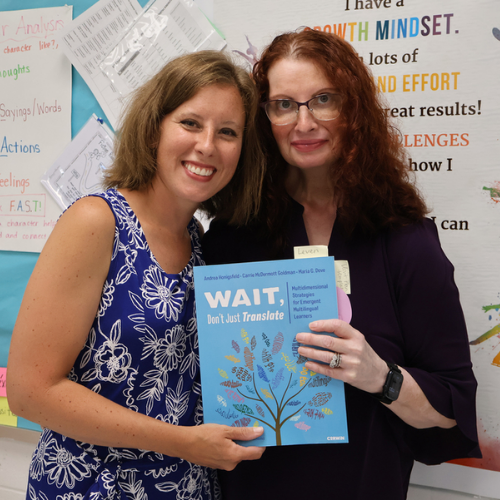
What happens when educators see students’ home languages not as barriers to learning English, but as resources for deeper learning? That question is at the heart of Wait, Don’t Just Translate, a new publication by Dr. Andrea Honigsfeld, Dr. Carrie McDermott Goldman, and Dr. Maria G. Dove, with illustrations by RBERN West’s own Dr. Claribel González. Among the educators featured are Katie Leven and Joyce Shear, ENL educators serving bi/multilingual learners through Orleans/Niagara BOCES in partnership with Niagara Wheatfield Central School District.
For Katie and Joyce, supporting bi/multilingual learners begins with recognizing the knowledge and language students already bring to the classroom. Katie has seen how students who are hesitant to take risks in English can build confidence when they are able to draw on their home language. “Using the home language helps them build up their confidence with formulaic language at the beginning,” she explains. Joyce similarly emphasizes that students’ home languages are valuable tools for thinking and learning, noting that “it is essential that we continue to allow our students to develop and nurture their home language(s) as a tool to deepen their learning.”
Their classroom practices make this belief visible. Katie uses a variation of the Picture Word Inductive Model, inviting students and families to discuss an upcoming topic in any language. This allows students to “access their whole linguistic repertoire and make connections to their prior knowledge” before beginning a new academic topic. Joyce uses side-by-side English and home-language materials, along with annotated exemplars and graphic organizers, to help students access challenging academic tasks. With these supports, she has seen students realize that “not only can they actually write these essays, but they can write them using very difficult texts.”
Their work reflects a broader New York State commitment to asset-based and culturally responsive approaches that amplify the experiences bi/multilingual learners bring to the classroom. Both educators emphasize that high expectations and honoring students’ identities go hand in hand. Katie encourages educators to “create a safe environment where you accept children exactly as they are”. Joyce reminds us that “bi/multilingual learners come to us with a plethora of gifts, talents and strengths.”
Their recognition in Wait, Don’t Just Translate celebrates not only two educators, but also the collaboration that makes this work possible. Both Katie and Joyce point to the supportive environment at Niagara Wheatfield and the partnership between the district and Orleans/Niagara BOCES as important to their students’ success. Their story reminds us that meaningful change can begin with educators sharing what works, learning from one another, and recognizing what bi/multilingual learners already know and bring to the classroom. What is one practice that has made a difference for students in your classroom? We want to hear about it! Have a success story, promising practice, or educator you'd like us to celebrate? Share your story with us here.